
A yard sign mockup shows a real estate sign placed in a front yard before anything is printed. It lets agents, landscapers, and home stagers check layout, color, and readability in context. It can also help carry a design across a matching set of print pieces, such as a flyer, brochure, and business card.
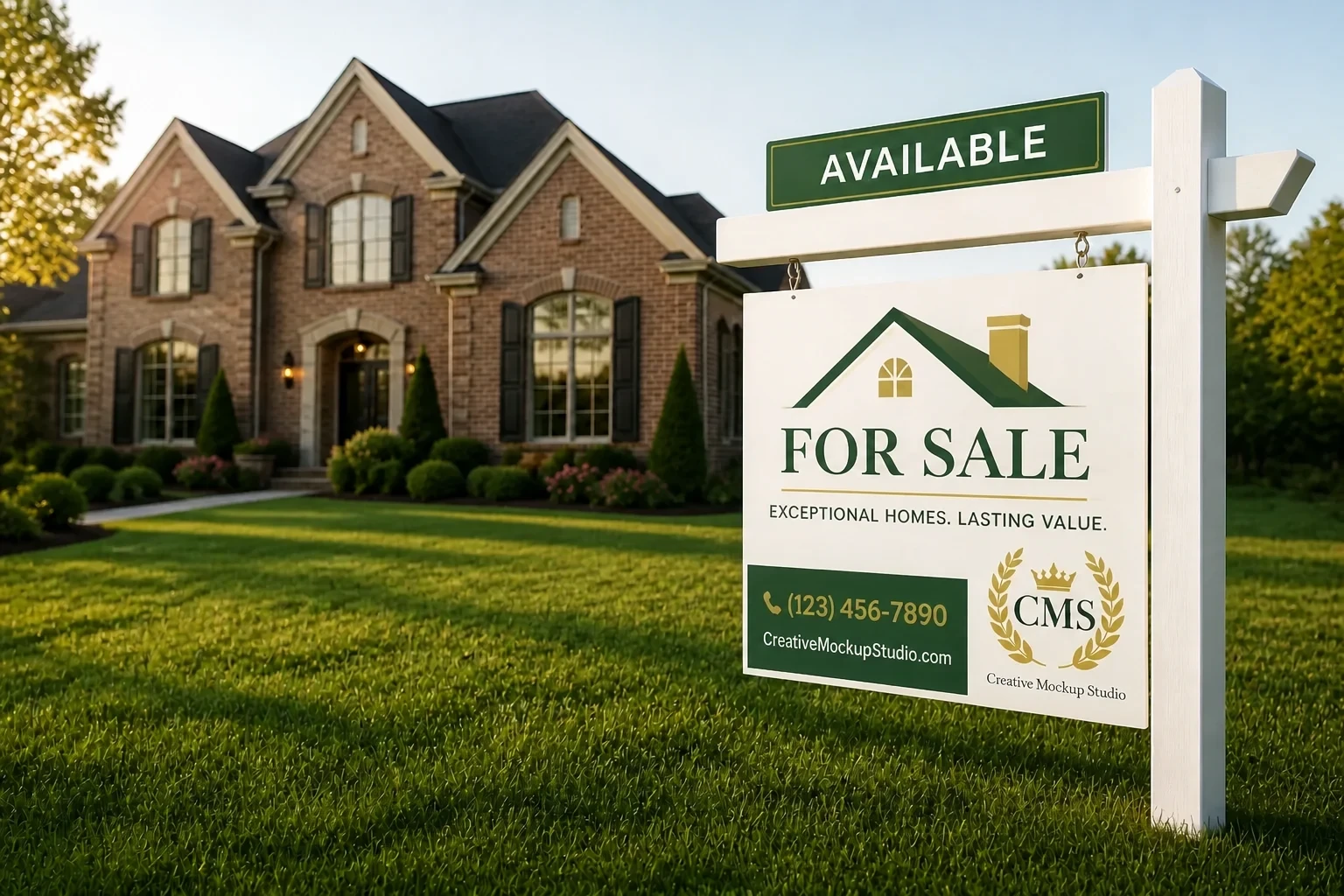
The mockup images in this post are AI-generated experiments, not photos of physical products. We do not own or handle the products shown.
We have not printed signs or worked with agents, so the printing and pricing sections focus on factors to consider and questions to ask a local printer.
What Goes on a Real Estate Yard Sign?
A real estate yard sign usually carries a status word such as “For Sale,” the agent or brokerage name, a phone number, and often a website or QR code. Much of the design work is deciding which details get the most space.
A sign is read by someone walking or driving past, often for only a moment. In our experiments, layouts with fewer, larger elements were easier to read in a scene. Here is what typically competes for space:
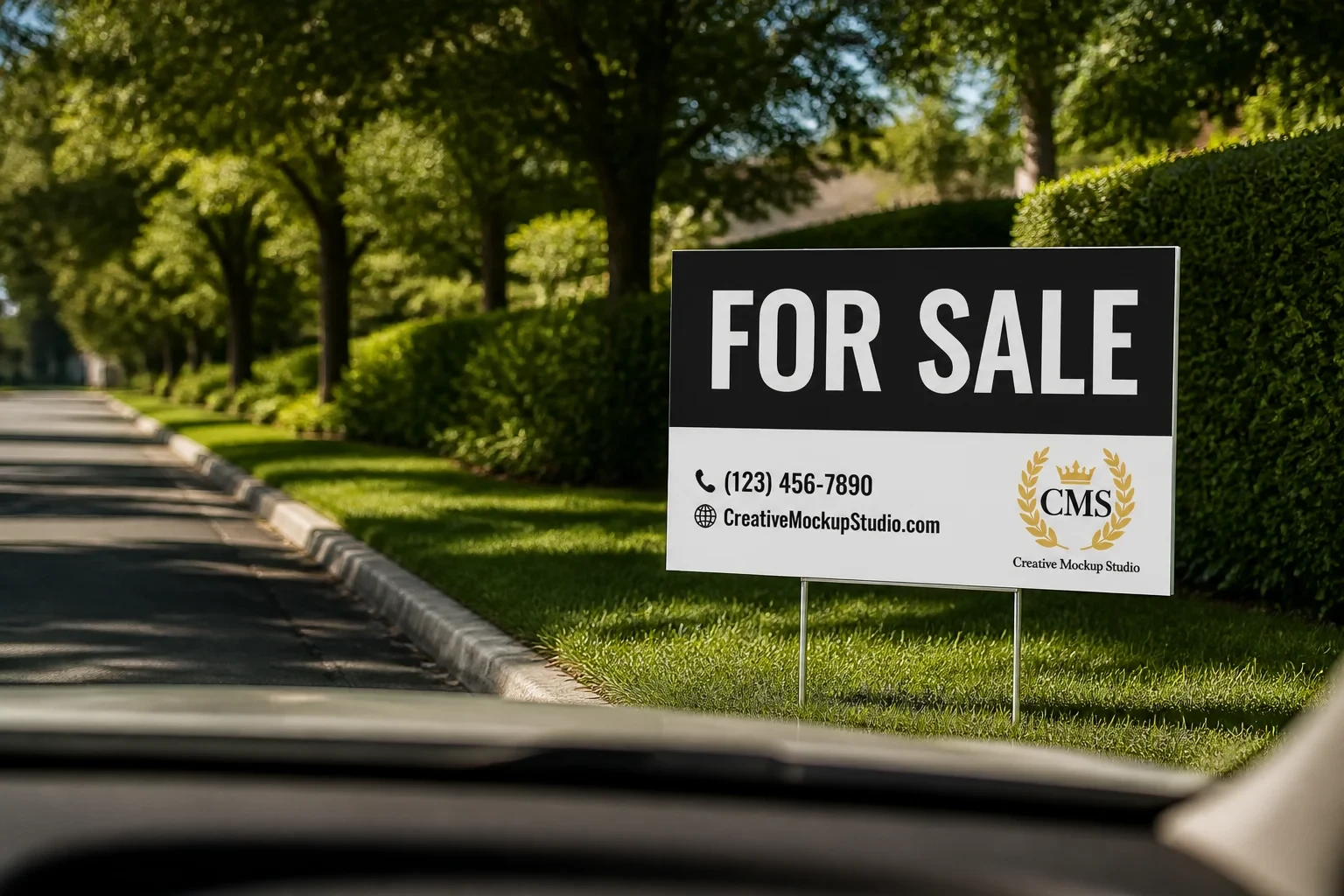
- Status line: “For Sale,” “Open House,” or “Coming Soon,” usually the first thing a passerby needs to read.
- Name or brand: The agent’s name, the brokerage name, or both, often with a logo.
- Contact method: A phone number, a website, or a QR code that leads to the listing.
- Rider panels: Add-on pieces that hang below the main sign, such as “Open House” or “Sold.”
- Headshot or tagline: Optional details that may be the first to cut when the layout feels crowded.
Many brokerages have branding rules, and some local areas have rules about what must appear on real estate advertising. Check both before finalizing a design. A mockup is a place to try layouts, but the brokerage or a local printer is the source to consult about requirements.
What Does a Yard Sign Mockup Show That a Flat Design Can’t?
A yard sign mockup shows how a design looks in a setting, against grass, siding, shrubs, and sky, and at the scale of an actual yard. A flat design on a white canvas hides all of that.
A layout can look balanced on screen and still feel different in front of a green lawn and a brick house. In our experiments, scene-based mockups made a few things easier to judge:
- Contrast: Whether the text color stands apart from the background colors around it.
- Scale: Whether the phone number looks large enough to read from the road in the scene.
- Space: Whether the sign looks crowded or empty compared with the yard around it.
- Mood: Whether the sign feels at home on a quiet suburban street, in a new development, or beside a rural property.
We build our scenes with online AI image-generation tools. The scene types we found useful for exploring yard sign designs included:
- Front lawn with the house behind: A classic listing-photo setup.
- Curbside sign near a sidewalk: A view of the sign from the street.
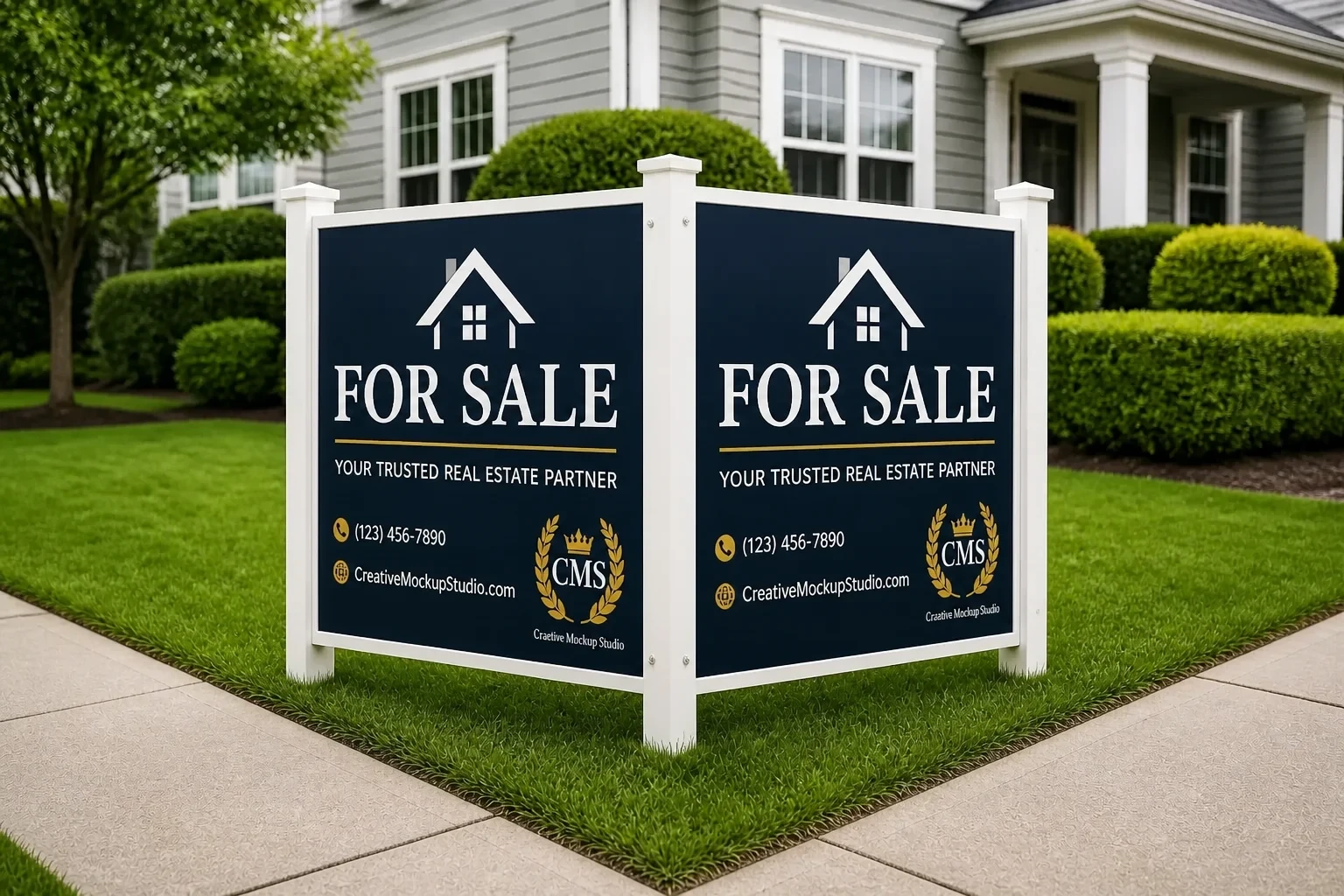
- Corner lot: A sign visible from two directions.
- Garden bed or landscaped entry: A sign among plantings, a setting that may also suit a few other businesses discussed below.
One caution: A mockup is a picture, not a proof. The real colors and finish of a printed sign depend on the material and the printer, so a digital scene is a planning aid, not a promise of how the physical sign will look.
What Affects the Cost of Real Estate Yard Signs?
Yard sign cost depends mostly on size, material, number of printed sides, quantity, and whether stakes or frames are included. We are not listing prices because we have not ordered signs and do not want to guess at numbers.
This table summarizes factors that may affect the price and questions to ask a printer:
| Factor | What to ask a printer |
|---|---|
| Size | Which sizes are standard, and does a larger size change the price by a little or a lot? |
| Material | What is the sign made of, and how does it handle sun, rain, and wind? |
| Sides | Is the design printed on one side or both, and does the second side cost extra? |
| Quantity | Do prices drop at higher quantities, and is there a minimum order? |
| Stakes or frames | Are stakes or frames included, or sold separately? |
| Riders | Can add-on panels be ordered with the main sign or later? |
| Turnaround | How long does production take, especially for a listing with a set date? |
Beyond the table, a few other questions are worth raising with a local printer:
- File requirements: Do they accept your design file, and what file format do they prefer?
- Material samples: Can they show you a printed sample of the material before an order?
- Color matching: Will they print colors that match a logo exactly, or is some variation normal?
- Changes or damage: What happens if a sign is damaged or needs a design change midway?
Local printers can answer these questions, and answers differ from shop to shop. Getting two or three quotes with the same specifications makes the comparison fair.
Is a Yard Sign Worth It for Realtors?
Whether a yard sign is worthwhile depends on the property, the street, and the agent’s goals. We cannot give a verdict because we have no listing results to share, but we can offer a way to think it through.
A yard sign does something a photo online cannot: It tells people on the street that a home is for sale and puts an agent’s name where neighbors and passersby can see it. Neighbors sometimes know someone looking to move into the area, and a sign is one visible way to reach them.
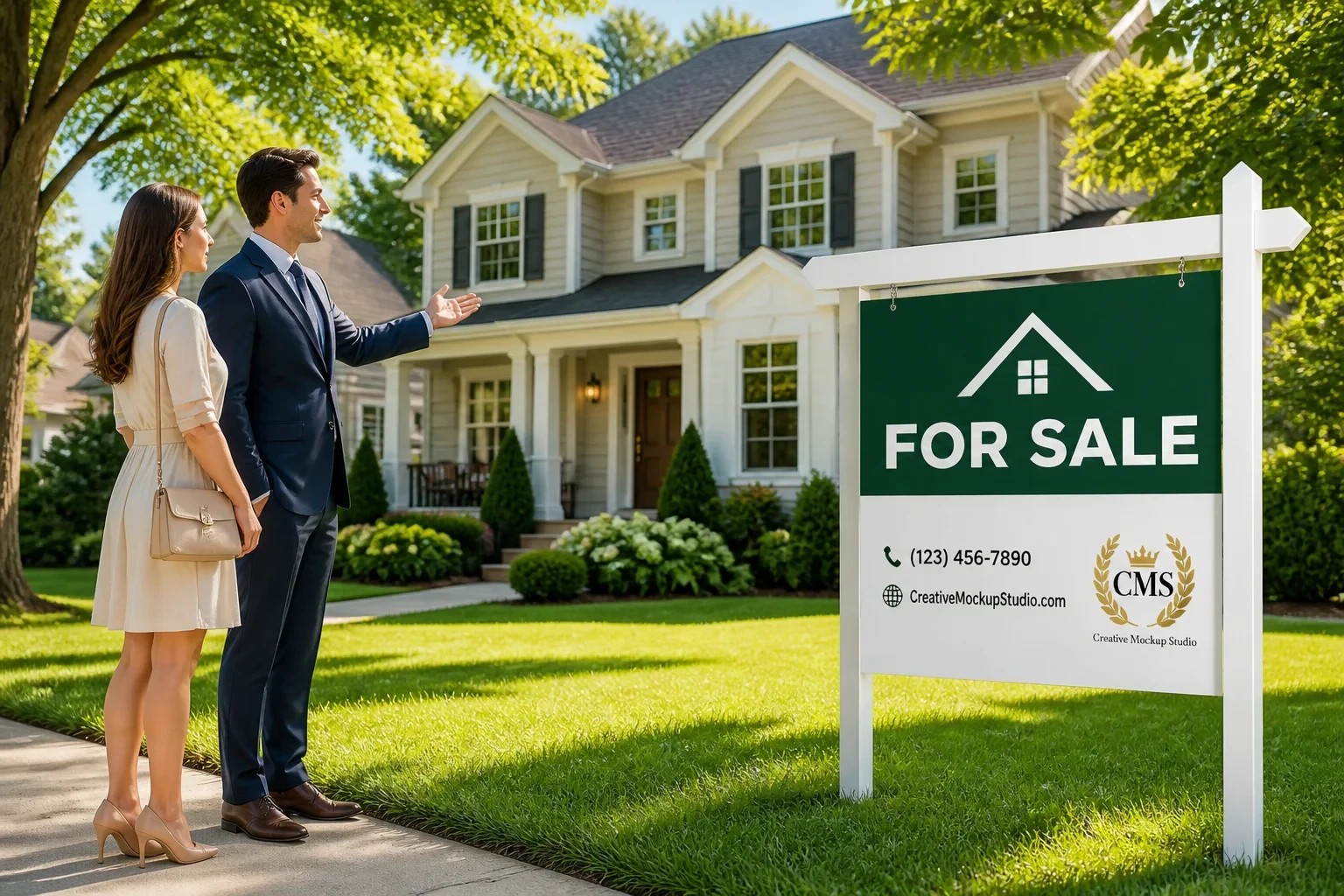
Questions that may help with the decision:
- Traffic: Is the street busy enough that people will see the sign, or quiet enough that few will?
- Rules: Do local ordinances or a homeowners association limit signs?
- Seller preference: Is the seller comfortable with a sign in the yard?
- Role in the mix: Does the sign work alongside online listings, flyers, and open houses?
Treat the sign as one piece of a set rather than a standalone item. A sign, flyer, and card that share a design may be easier to recognize if someone sees more than one. We cannot say how much that helps, but it is a reasonable idea to test in a particular market.
How Do Yard Sign Mockups Work for Landscapers and Home Stagers?
The same yard scenes may suit landscaping businesses and home stagers because both can use signs in front of a property to show their work. The text and the role of the sign change.
For a landscaper, a sign in a freshly planted yard can mark completed work. A scene with a lawn, mulch beds, or a walkway lets a business owner explore how a company name and logo might look beside real plants. Greens in the surrounding yard matter here, because a green logo can disappear against a green lawn.
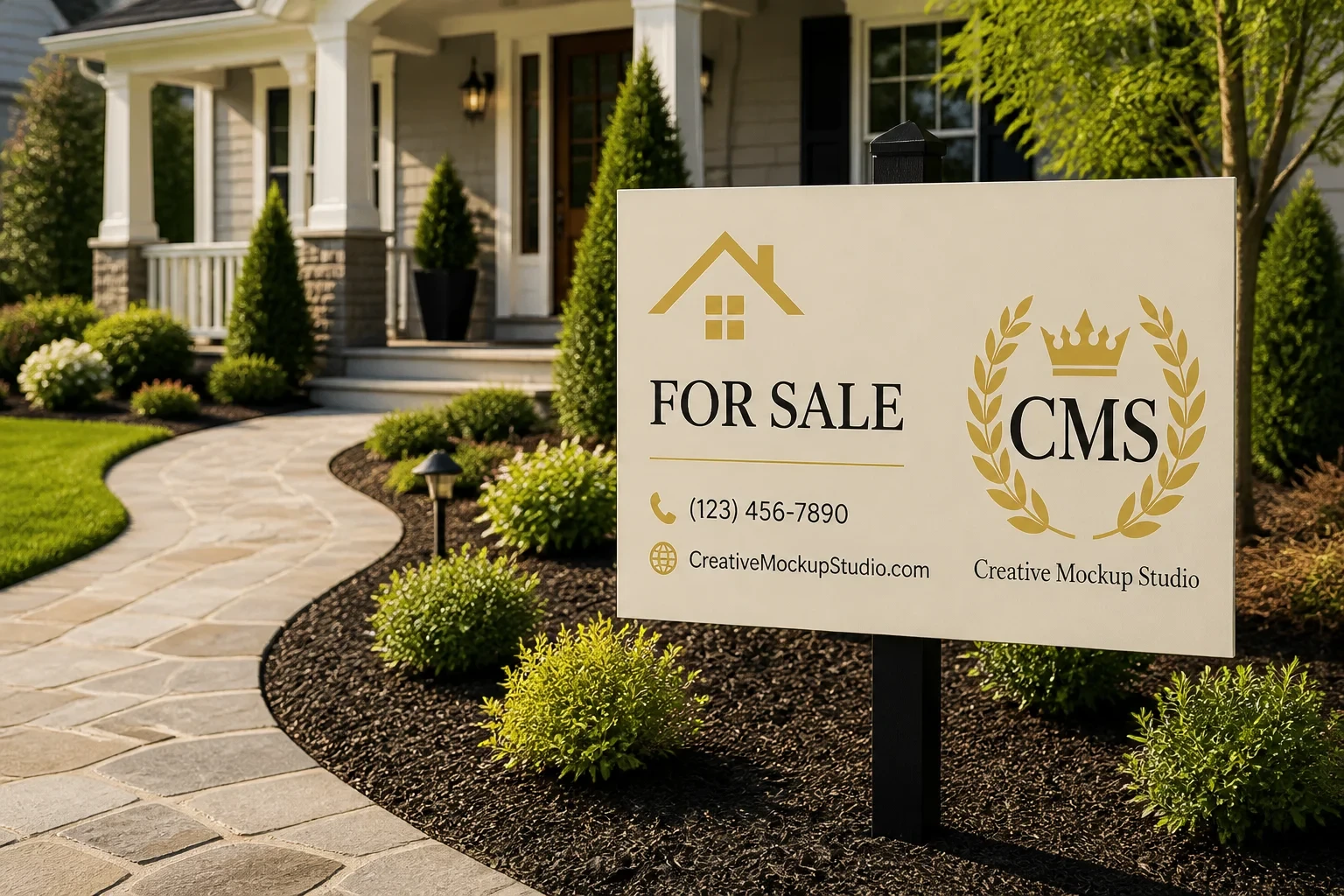
For a home stager, a sign might say a home was staged by the business, placed where the listing agent and homeowner agree. A scene with a clean front entry and a tidy porch can help present a polished, welcoming brand.
Some ideas to explore for either business:
- Color contrast: Try a darker sign against light siding, then a lighter color against dark siding, and compare.
- Message length: Keep the message short, such as a business name, a short descriptor, and one contact method.
- Scene framing: Test the sign as the main subject and as a smaller element in a wider scene.
We have not worked with landscapers or home stagers, so these are ideas, not professional advice.
Permission matters too: A sign on someone else’s property needs the owner’s agreement, and local sign rules still apply. The matching flyer and card ideas below could also be adapted for either business.
What Makes a Listing Flyer or Open House Flyer Match the Sign?
A flyer matches the sign when it reuses the sign’s colors, logo placement, fonts, and main phrase. Someone who sees the sign and then picks up the flyer can recognize both as part of the same listing.
A listing flyer typically uses standard U.S. Letter paper, which gives more room than a sign. That space can hold photos, a short description, and details a sign leaves out. An open house flyer adds the date and time and can emphasize the “Open House” wording used on the sign rider.
One idea is to build the set in order, so each piece inherits from the one before:
- Settle the sign design first, since it has the least room and the most constraints.
- Pull the sign’s two or three main colors into the flyer headline and accents.
- Repeat the sign’s status phrase as the flyer’s headline.
- Place the same logo and contact method in a consistent spot.
- Add the extra details the sign could not hold, such as photos and the property description.
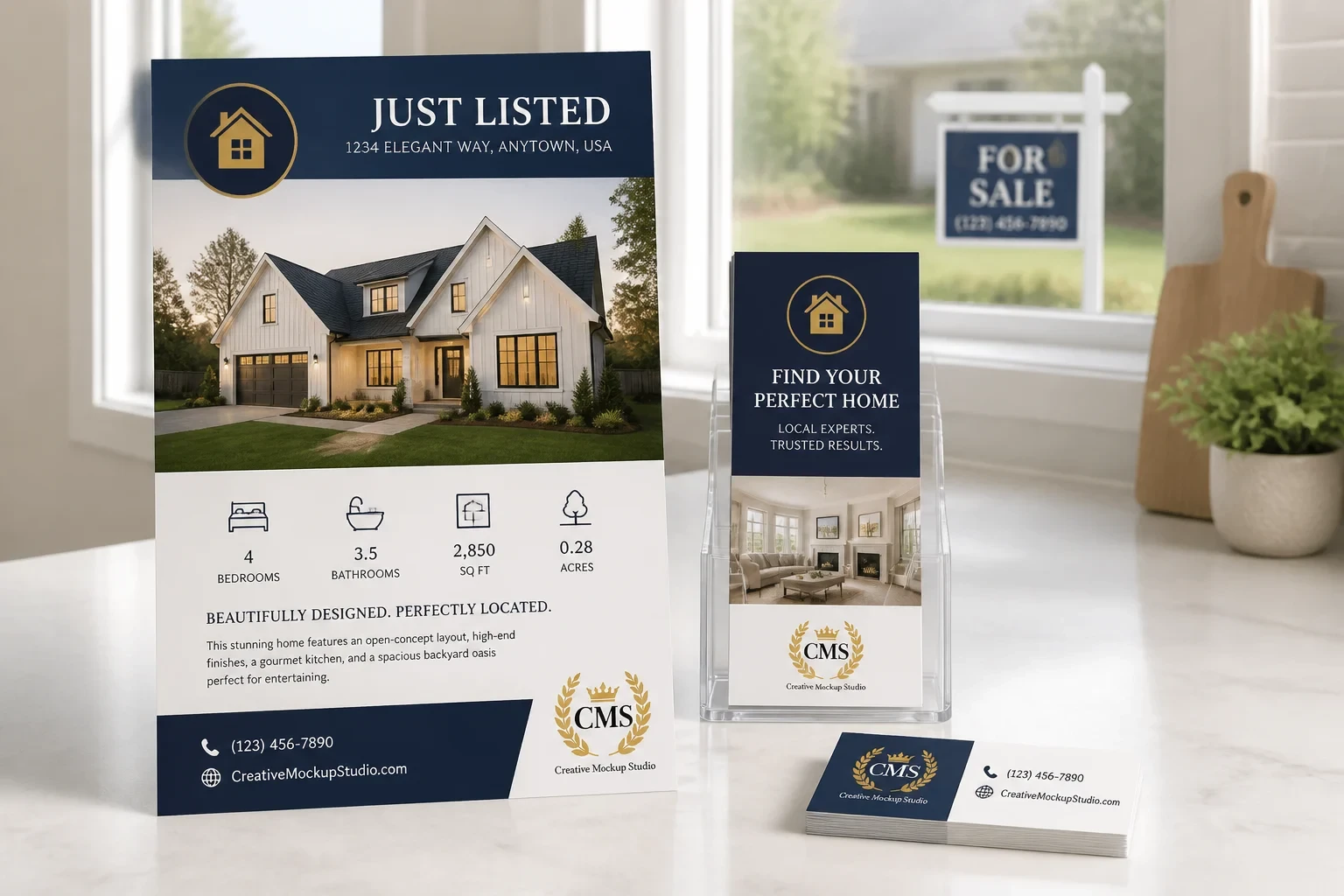
A mockup can help with the flyer as well. A scene showing a flyer on a kitchen counter, in a brochure holder, or at a sign-in table lets a business explore how it looks in a setting where people might pick it up. Digital scenes like this may also work as Pinterest visuals, though we would treat any benefit as a possibility, not a guarantee.
What Belongs in a Property Brochure or Tri-Fold?
A property brochure holds the longer story: a strong cover, property highlights, a few photos, and the agent’s contact information. A tri-fold, which folds a Letter-size sheet into three panels, gives that story a natural order.
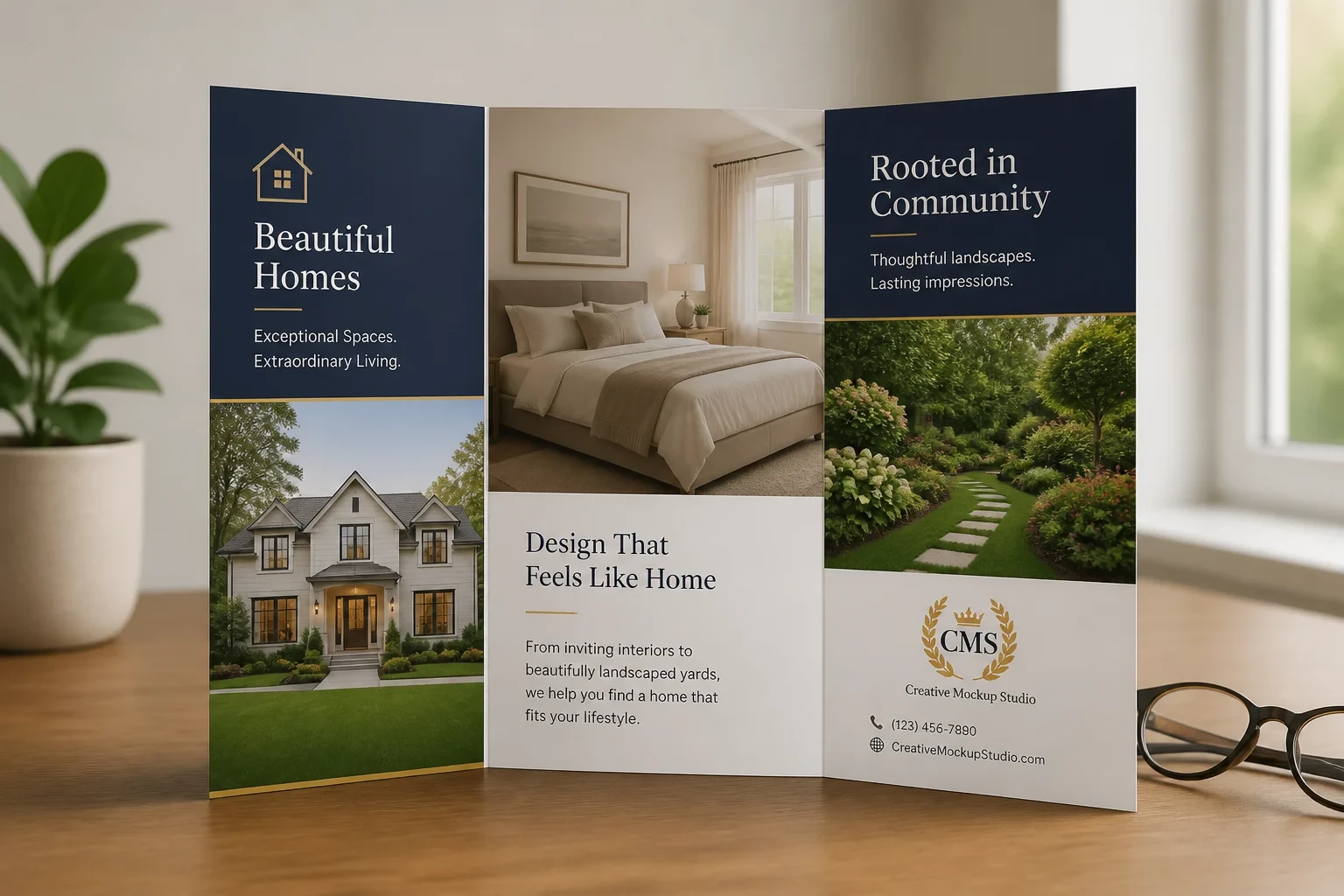
Here is one way to lay out the panels:
- Cover panel: Use the sign’s main image or headline so the brochure is recognizable at a glance.
- Inside panels: Add property highlights, a short description, and photos of key rooms or outdoor spaces.
- Back panel: Include the agent’s photo or logo, contact details, and the same QR code used on the sign.
The cover is where the matching idea matters most. If the sign uses a particular color block or border, the brochure cover can repeat it. Keeping the fonts and logo position consistent lets the set read as one brand even when the pieces differ in size.
For a landscaping business or home stager, the same structure can hold project photos, a short list of services, and a way to get in touch. A tri-fold mockup is also a way to preview how the panels look when the brochure is held or placed on a table. Confirm folds and panel sizes with a printer before finalizing. A printed sample is the only way to see how the paper stock and folds actually look.
Are Business Cards Still Effective for Realtors?
Business cards can still be useful for realtors as a quick handoff at open houses and in-person meetings, but we do not have data on how effective they are. The answer depends on how an agent meets people.
Cards help when someone is standing in front of you and wants a way to follow up. At an open house, a card on the table next to the flyers gives visitors something small to keep. Much of the contact information is also on the sign, so the card’s job is to carry the brand into someone’s wallet or pocket.
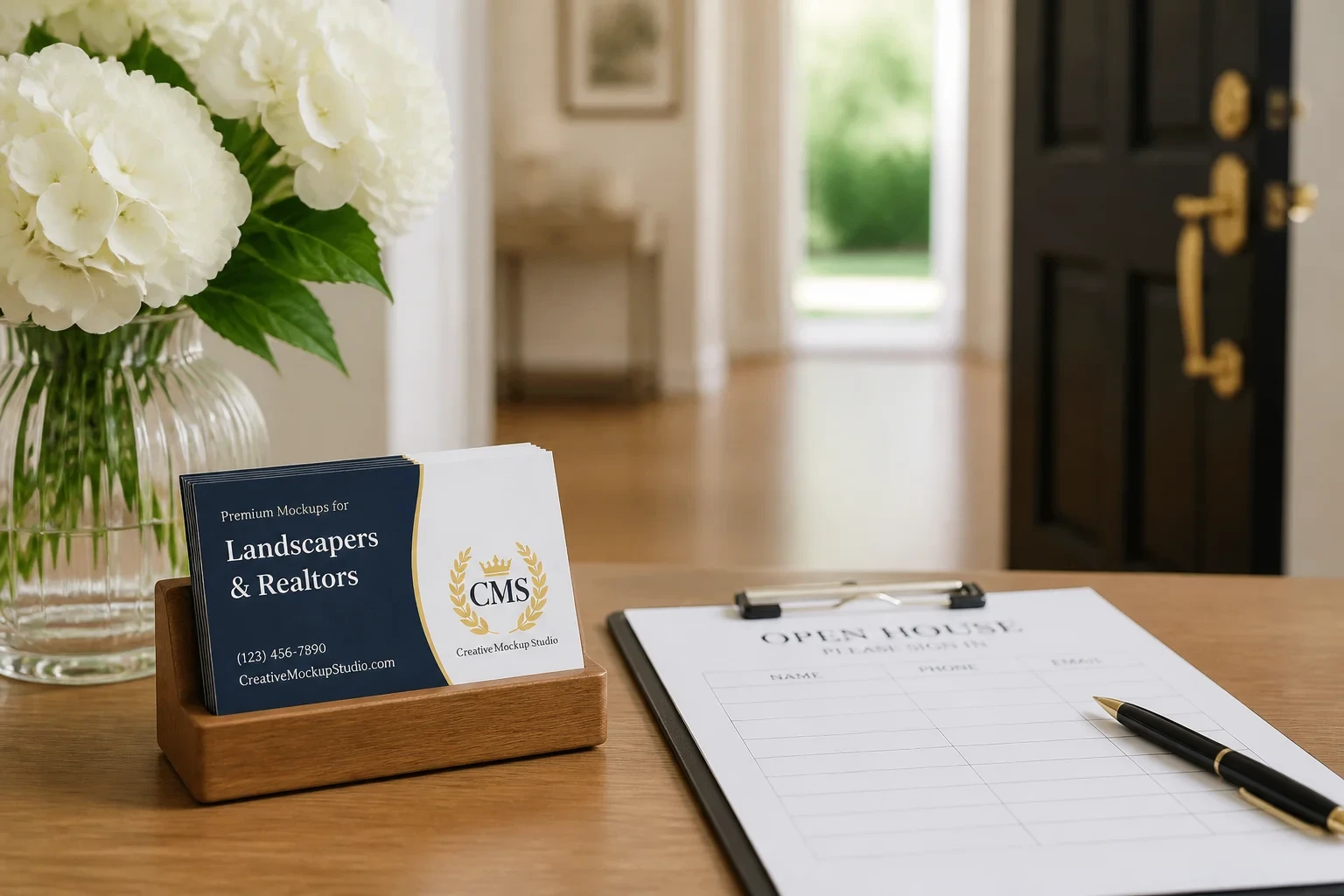
For a matching set, the card is the smallest piece and can be kept simple:
- Brand: Use the same logo and color palette as the sign.
- Contact method: Include one clear option, usually a phone number or website.
- QR code: Add one only if it leads somewhere useful and is large enough to scan.
A few questions can help decide whether cards are worth printing for a particular market:
- In-person meetings: Does the agent regularly meet people in person?
- Digital alternatives: Would a digital contact share replace the card in most cases?
- Placement: Is there a place, such as an open house table, where cards will be seen?
As with signs, we cannot speak to results. A card that follows the sign’s design is one possible way to extend a set.
What Stood Out While Making Real Estate Yard Sign Mockup Scenes?
In our experiments, the main takeaway was that a yard sign has little room for text that needs to be read from a distance. A scene made it easier to judge whether that text looked clear. These are observations from digital experimentation, not professional printing advice.
A few points stood out:
- Less text reads more clearly: A sign with a status word, a name, and one contact method looked easier to read in a scene than one with five elements.
- Surroundings change the design: Lawn, siding, and sky all affect how a color looks, so one scene may not be enough to judge a layout.
- One scene can suit different businesses: The same yard settings can be explored for realtors, landscapers, and home stagers with different sign text.
- A matching set can start with the sign: The smallest and most constrained piece can help guide the design of the rest.
Our work with these scenes is digital only, so a local printer and the brokerage are the right sources for price, materials, and local sign rules.
These ideas may also help landscapers and home stagers who want to preview a sign in a yard before ordering. Browse more of our scenes and styles on our Collections page, and tell us which mockup you would like to see next. If you want to try a scene of your own, you can explore Kre8or.ai, one of the online tools we use.